Showing posts with label travel. Show all posts

Spring Break Out the Fat Pants – Part 2

As promised, here’s a bit more about our Spring Break trip - a stop at the fabled Tillamook Cheese Factory.

Photo by Susan Wenzel

Tillamook cheese is sold throughout the United States, but their products are undeniably local favorites here in the Pacific Northwest – especially their award winning medium cheddar cheese.  My mother-in-law insists only it will do in her amazing chicken, broccoli, and cheese crêpes, and I agree.  So, it was only natural that I too fell under the spell of their cheese, butter, sour cream, ice cream (40 flavors – give or take), and yogurt (Baked Apple Pie and Banana Vanilla are my kids’ favorites) shortly after moving back to Washington State. 

And, after hearing what fun others had at the cheese factory, we knew a stop to see where these dairy delights were made would be included in our road trip through Oregon - and why not, travel = food in our family, right?  (When we went to Hawaii this last time, one of our first stops was the Mauna Loa Macadamia Nut plantation!) 

Photo by Susan Wenzel

After our visit to VooDoo Doughnuts in Portland and a couple days staying with family near Salem, we headed west.  My kids counted off the miles that morning until they finally spied the huge yellow sign welcoming us to our next culinary destination. 

Photo by Susan Wenzel

Once inside the factory, our first stop was the self-guided tour where we saw the cheese go from raw milk (courtesy of the 100+ local farms comprising the Tillamook County Creamery Association) to blocks of curds and finally chopped into the familiar, red wrapped, two-pound loaves.  As an organic milk convert, I was pleased to learn that, while Tillamook does not offer organic products, all of the milk they use comes from cows that are NOT TREATED with rBST (a hormone injected into dairy cows to artificially increase milk production) – a fact that is good enough for me. 

Photo by Susan Wenzel

Speaking of facts, here’s an interesting one about cheddar cheese:  did you know it is naturally white and that it has to be colored orange?  Tillamook adds annatto (the seed of the tropical achiote tree used almost exclusively as a natural food dye) to give their cheddar its appealing orange tint. 

Photo by Susan Wenzel

The endless conveyer belts of cheese snaking around and around the production room floor made us understandably hungry, so we made our way to the samples…which where delicious (cracked black pepper was exquisite) but only served to whet our appetites.  Conveniently in our path was the café where we perused the menu but all opted to order the oh-so-obvious choice of grilled cheese sandwiches and tomato soup.  (I mean, really, what better place?)  

Photo by Susan Wenzel

Maybe it was the waterfall of ooey-gooey cheese pouring out from between the perfectly toasted slices of bread or maybe it was the atmosphere of eating in a cheese factory, but we all agreed they were The Best Grilled Cheese Sandwiches EVER (my stomach is growling just thinking about it) – and the soup was certainly nothing to sneeze at either – it was amazing and only made the sandwich that much better when dipped into its rich red creaminess. 

After lunch, we hit the cheese store and bought an assortment of cheesy goodies – fresh curds, Vintage White Extra Sharp Cheddar, Garlic White Cheddar, a big block of our favorite medium cheddar, and my true love – Hot Habanera cheese.

Just before we bid adieu to this Disney Land of Cheese, we had to make a final stop – to get Tillamook ice cream, of course.  Between the four of us, we sampled eight flavors and finally left – stuffed but satisfied. 

I didn’t really have to don my fat pants when we got home.  Thankfully all of the hiking along the dazzling Oregon Coast offset the calories – I’m sure.

Photo by Susan Wenzel

Cup 'O Joe By Any Other Name

I never used to be a regular coffee drinker but lately can’t seem to get my day started without it. I’m fond of Starbucks but only occasionally order anything but their brewed coffee as both the price and the calorie content of some of their featured items scare me (although once or twice a year I indulge in a Cinnamon Dolce Latte or a cappuccino). My frugal side spurs me to make the majority of my own coffee at home, but because I fancy myself a sort of coffee connoisseur, I've found the fair-trade organic blends from Trader Joe’s (they have a few) nicely suit my daily needs.


(A Fair Trade Certified designation, in theory, marks goods that pay the farmers producing them - typically coffee, tea, chocolate and sugar - a larger percentage or "fair" amount of the proceeds. For more on this, see http://www.transfairusa.org/)

Regular coffee aside, my Vietnamese coffee post prompted me to think about other “exotics” I’ve tried both here and abroad. Of course I’ve had Jamaican Blue Mountain and Kona coffee; indeed, when I was on the Big Island in April, I visited a coffee co-op and bought plenty of Kona for me and some to share. But, I suppose my two absolute favorites are of the Greek and Turkish varieties. Although I’d tasted Greek coffee at our local Greek food fest, the cup I had in Crete was second to none. I was able to watch the curator grind the beans in an ancient looking mill, carefully spoon out just the right amount of fine powdered coffee from the mill’s wooden drawer, simmer my single serving in a small metal pot known as a briki and slowly pour the rich, dark brew, grounds and all, into a white porcelain demitasse topped with the lighter brown foam left clinging to the sides of the pot. Delicious.

(Greek coffee is made with or without sugar. The amount or a lack thereof sugar is identified by the name. Sketos = no sugar, metrios = a little sugar, glykos = a lot of sugar, vary glykos = extra strong coffee with extra sugar.)


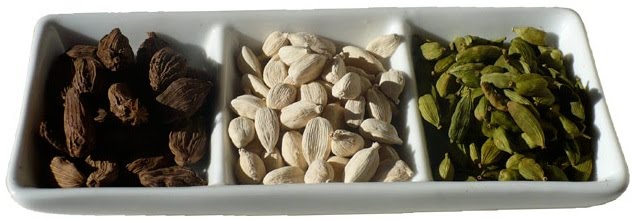
Turkish coffee is prepared in the same manner as the Greek coffee and indeed is often referred to as one in the same (although the Turkish beans traditionally have a far darker roast). Finely powdered coffee - sugar or no - is also brewed in a long handled pot called a cezve.  Not unlike a briki in form and function, this Middle-eastern version is traditionally made from copper and a bit more ornate.  Additionally, Turkish coffee is frequently spiced with cardamom. Cardamom, of the ginger family, is indigenous to India but also grown in South America. Available in whole pod, seed or powder form, it is widely used throughout Indian cooking from curries to desserts and even to season steamed basmati rice. In the Middle East, where I lounged on a red velvet couch to enjoy my first cup of Turkish coffee, cardamom is used to add flavor to both coffee and tea.


I don't have the capicity to grind my coffee beans as fine as is required for either of these, nor do I have plans (unfortunately) to travel overseas again any time soon, but I have learned to make due.  A couple brands of pre-ground Greek coffee can be found in specialty markets, and I satisfy my Turkish coffee crave by grinding a whole cardamom pod (purchased from http://www.thespicehouse.com/, of course) with my regular beans before brewing. 

Thanks to these last couple posts, in addition to a Vietnamese coffee press (I've now learned is called a cà phê phin), I now feel the need to find a briki or perhaps even a cezve.

(Thank you to http://www.thespicehouse.com/ for the cardamom picture and to http://www.freshcoffeeshop.com/ for the cezve picture)

Loco Moco


Some time ago I wrote about the famous plate lunch that epitomizes popular Hawaiian cuisine (at least in my mind). When I was on the Big Island in April, I was able to get my plate lunch fix by going to L&L drive-ins on two separate occasions. The food was good and plentiful as ever, and even though I shared one three ways, we were unable to finish the rice, macaroni salad, bbq beef, chicken, and short ribs that are included on the “combination plate.”


Another thing I had to have was loco moco. A stop at Ken’s House of Pancakes in Hilo was the sure place to order up a bowl. Considered the ultimate Hawaiian comfort food, this dish is comprised of a generous serving of steamed rice topped with a hamburger patty then one or two over-easy eggs and finally a rich brown gravy. Delicious!  (For the hearty eater, Ken’s offers the Sumo Moco made with six scoops of rice, two hamburger patties, and three eggs all smothered with gravy, and when this dish is ordered, a bell is rung and everyone in the place yells, “SUMO!”)


I pride myself in cooking delicious, nutritious, vegetable intense foods for my family but have been craving loco moco for days now, so that’s what we had for dinner.  (My daughter did point out that I used farm-fresh organic eggs and lean beef)  As I sat down to the steaming, delicious smelling bowl of gravy drenched Hawaiian Heaven, I almost felt like I was back in the islands…

Visit Ken’s online or be sure to eat there when you go to the Big Island – just turn right out of the airport and go a little way. (Order the most awesome pancakes - available 24/7 and served with Guava, Passion Fruit and “Kokonut” syrups, Yum!) http://kenshouseofpancakes-hilohi.com/

MMMMaple syrup!

This weekend we are heading to the Highland County Maple Festival. People often think of Canada or, in the US, Vermont when they think maple syrup, but this delicious, natural sweetener can be produced in any place where maple trees grow – any place that has a periodic cold climate – including Virginia.


Maple water (sap), primarily from the Sugar Maple (Acer saccharum), is gathered when the sap is flowing. This phenomenon is induced by the cold nights and warm days of spring (February, March and April depending on the latitude and the weather). The science of syrup production is an intricate system of boiling, reducing, straining and grading. (Did you know it takes about ten gallons of sap to make one quart of syrup?!) The end result is always a rich and flavorful, sweet liquid gold ranging in shades (also known as grades) from a light to dark amber. I personally couldn’t care less about the grade – it’s all good to me.

I love maple anything – especially maple sugar candy - and have since I was a child. Please don’t even think about serving me that fake pancake syrup (Sorry, Aunt Jemima). I use real maple syrup on French toast, pancakes, waffles, oatmeal, and even dip my sage pork sausage in it. I add it to baked beans, sweet potato dishes, and other recipes I feel need a sweet but not sugary touch.

Last year when we went, both to eat fresh, warm maple doughnuts and to visit our friends who live there, the lady of the house suggested I try a spoon in my coffee instead of sugar. I was hesitant to mess with my morning java and didn’t take the plunge despite my affinity for mapleliciousness. Later at home, curiosity got the better of me and I gave it a try. It was superb!

Need an excuse for eating some maple syrup? Try my favorite French Toast recipe compliments of Alton Brown. The baking of the finished product is key to this dish. It is the only way I make French Toast now (I added vanilla and cinnamon to the custard):

Ingredients
• 1 cup half-and-half
• 3 large eggs
• 2 tablespoons honey, warmed in microwave for 20 seconds
• 1 teaspoon vanilla
• 1/2 to 1 teaspoon cinnamon (depending on taste)
• 1/4 teaspoon salt
• 8 (1/2-inch) slices day-old or stale country loaf, brioche or challah bread.  Regardless of the bread it MUST be stale!
• 4 tablespoons butter

Directions
~In medium size mixing bowl, whisk together the half-and-half, eggs, honey, vanilla, cinnamon and salt. (I do this the night before.) When ready to cook, pour custard mixture into a pie pan and set aside.
~Preheat oven to 375 degrees F. Dip bread into mixture, allow to soak for 30 seconds on each side, and then remove to a cooling rack that is sitting in a sheet pan, and allow to sit for 1 to 2 minutes.
~Over medium-low heat, melt 1 tablespoon of butter in a 10-inch nonstick saute pan. Place 2 slices of bread at a time into the pan and cook until golden brown, approximately 2 to 3 minutes per side. Remove from pan and place on rack in oven for 5 minutes. Repeat with all 8 slices. Serve immediately with warm maple syrup.

Links:
http://highlandcounty.org/planyourtrip.htm
http://www.foodnetwork.com/recipes/alton-brown/french-toast-recipe/index.html


Beyond Pineapples and Poi


Very soon I will return to Hawaii for a couple weeks of vacation. Some people go for the sun and the beaches and the soft tropical breezes. While I deeply enjoy these, especially the sweet scented air that wafts to your nose the second you step off the plane, I also go for the food.

Hawaiian food, or should I say the food you can get in Hawaii is like none other. Two scoops of Polynesian blended with a side of Korean and a dash of Japanese best describes much of the food there. An excellent example of this is the traditional “plate lunch” usually served with a scoop of potato-mac (just like it sounds - potato and macaroni salad with tons of mayo), steamed white rice, and a main meat like kalbi (Korean marinated and grilled beef short ribs) or chicken katsu (pounded thin, breaded and fried chicken cutlet akin to the Japanese tonkatsu). 

Plate lunch can be found about anywhere in Hawaii – in a strip mall, at a roadside stand or from a lunch wagon at a local surf contest. A popular place to get plate lunch has found its way to the mainland in the form of L&L Hawaiian BBQ (called L&L Drive-in or just L&L in Hawaii). Check out this eye candy: www.hawaiianbarbecue.com/  


I mentioned my love of Spam in a previous post. Well, Hawaii is a good place to get my fix. (mmmmm…Spam musubi) Several stories try to explain Hawaii’s love of Spam. Regardless of which one you believe, Spam is everywhere – even on the McDonald’s menu. Mainland has its Big Breakfast, but Hawaii has its Spam, Eggs and Rice. Oh…and Portuguese sausage Eggs and Rice! I love Portuguese sausage! Last time when we flew back, I packed about 6 long links in my luggage (two spicy and four regular).

Another favorite, and the one my husband is most looking forward to, is the huli-huli chicken. Any given weekend, someone somewhere is cooking huli-huli – probably for a fundraiser. Look for the smoke and head towards it. You will probably end up in a grocery store parking lot waiting in a line of cars for your share. Just drive up when it’s your turn, hand the man your money and get a whole crispy, juicy, salty, messy, delicious rotisserie-style chicken (or two) in a bag. You better have some napkins though, because most people start eating in the car.

Now, everyone has their secret marinade recipe containing some mixture of shoyu (soy sauce), pineapple juice, brown sugar, ginger, garlic and more, but I have been using the Aloha Barbeque Sauce for close to twenty years and love it. The problem is getting it back home. One time I put a gallon bottle in my carry-on. You should have seen the local Hawaiian dude at customs when he saw it. He laughed out loud and said, “Don’t leave home witout it, eh?!” and passed me on through inspection.  Last time security restrictions prevented me from that method, so I bought several quart bottles, double zip-locked them, put them in the checked bag (along with two five-pound bags of Hawaiian sea salt and some NOH Hawaiian Poke mix) and said a prayer. The huli-huli gods must have been smiling on me, because all the bottles made it home without leaking.

So, if you get a chance to go to Hawaii, skip the tourist luau and hit some of the local eateries. I guarantee you will not be disappointed. Oh, and would you stop by 7-11 and bring me back some ginger cookies from the Hawaiian Candy Company? Please? www.hawaiicandy.com/ 


Gold, Frankincense & Saffron


Yesterday I received a Christmas package from my sister-in-law containing gifts for the girls and spices for me. A few weeks ago she told me about a new spice market near her house in South Pasadena and asked if I wanted anything. I had just placed a big order from http://www.thespicehouse.com/ but had forgotten a couple items. As I planned to make pfferneuse and gingerbread from an old German recipe, I told her I would deeply appreciate allspice and “real” cinnamon. **I most recently learned – I think from Alton Brown – that most cinnamon sold in stores is not really cinnamon (Cinnamomum verum) but cassia (Cinnamomum aromaticu) – a close relative.


This made me start thinking about spices ...how much I didn’t know then, how much I know now, and how much I still have to learn. Case in point: About ten years ago I visited Bali in Indonesia and very near The Spice Islands (aka Maluku Islands) – so named for the abundance of spices grown there. Unfortunately, at that time I was not as enamored of cooking as I am now and missed my chance to stock up. I did, however, buy whole nutmeg, anise, cloves and a bunch of other goodies for my Aunt Carol who is a cooker extraordinaire.

Years later I found myself in the middle-east, Dubai to be exact, and made a point of visiting a couple of the souks (Arabic for market). Souks, I soon learned, are both market places and festival places. The range of goods sold in each and the opportunities for people watching were mind-boggling! At the gold souk, I gawked at the millions and millions of dollars of gorgeous gold jewelry (sold by the gram regardless of the workmanship involved) on display in each storefront and finally settled on an intricate 22k filigree ring for $15(US) a gram ($466 an ounce – a good deal at the time).

Photo by Susan Wenzel

Then…I ventured into the spice souk. Surrounded by the kaleidoscope of colors and panorama of smells emitting from row after row of huge burlap bags and bins of every kind of spice, herb and nut imaginable – I was quickly approaching sensory overload. After gathering myself, I was determined to not make the Bali mistake. Now older and wiser, I purchased all kinds of amazing items including premium grade frankincense (not a spice but a highly prized tree resin used in perfumes and incense) and then honed in on my intended target – saffron. Saffron, stamen from the saffron crocus (Crocus sativus), is one of the most expensive, highly prized items in the food world. (I most recently saw 1 gram for sale in a specialty market for $9). This fragrant and richly colored spice is loved just as much for the exotic aroma and taste it imparts as it is for the golden hue it gives to rice, chicken or even custard. After passing on bins of yellowish-orange saffron in one crowded little store, I succeeded in persuading the merchant I meant business. He finally pulled a small tin from a shelf behind the counter. This was the stuff I was looking for – the good stuff. After parting with about $12, I walked away with nearly a full ounce of rich smelling, deeply red colored tiny curls of saffron.

My penchant for purchasing spices both at home and abroad has earned me the nickname of “Spice Girl.” Although I’ll admit I’ve moved far beyond seasoning my food with only salt and pre-ground pepper, there are so many more spices to learn and flavors to explore!